Why Your Paycheck Feels Gone so Fast (and What to Do About It)
From Moolah Habits · Financial coaching experience and credentials
Feel like your paycheck disappears too quickly? Learn how bills, everyday spending, and irregular expenses can eat up your money before you realize it, and how to give every dollar a job.

The Short Answer
A paycheck can disappear quickly because bills, everyday purchases, and irregular expenses already have a claim on it. Assign money to those needs, savings, and debt payments before deciding what is available to spend.
Payday comes around, the money hits your account, and for a minute everything feels fine.
Then the bills come out. A couple of small purchases happen. Something you forgot about pops up. And suddenly you’re looking at your checking account wondering how the paycheck disappeared so quickly.
It doesn’t necessarily mean you’re terrible with money. A lot of the time, the problem is that the paycheck already had more jobs than you realized.
The goal isn’t to stop spending altogether. It’s to know where the money needs to go before it starts going there on its own.
Bills Take the First Bite
Most paychecks don’t arrive completely available to spend.
Before anything else happens, there may already be money needed for housing, utilities, insurance, minimum debt payments, phone and internet, childcare, transportation, subscriptions, and other recurring bills.
If $2,000 hits your account but $1,350 is already needed for bills, you really aren’t starting with $2,000 of spending money. You’re starting with $650.
Looking only at the bank balance can make it easy to spend money that already has a job.
The Small Stuff Starts Stacking Up
The next part usually doesn’t feel dramatic. It might be $12 for lunch, $18 for takeout, and $14 during a quick store run.
None of those purchases looks like the reason a paycheck disappeared. Together, though, $12 + $18 + $14 = $44. And that may only be one day.
This isn’t about never getting coffee, ordering dinner, or buying something you enjoy. The issue is when everyday spending happens without a clear amount set aside for it.
Then Come the Expenses That Aren’t Monthly
Some expenses feel unexpected even though they happen fairly regularly: car repairs, birthdays, school expenses, annual memberships, holiday spending, medical copays, home repairs, pet expenses, registration fees, and annual insurance bills.
If a $600 expense comes around once a year, setting aside $50 each month can make it much less painful when the bill arrives.
That’s the idea behind a sinking fund: turn a larger future expense into smaller amounts you can prepare for over time.
Your Bank Balance Is Not the Same as Available Money
The number showing in your checking account tells you how much money is physically there. It does not automatically tell you how much is available to spend.
Before deciding what’s available, subtract money already assigned to upcoming bills, savings, debt payments, groceries and transportation, irregular expenses, and other planned spending.
What remains is much closer to your actual spending number.
Give Every Dollar a Job Before You Spend It
You don’t need an incredibly complicated budget. You do need a plan.
When a paycheck arrives, decide what the money needs to accomplish before everyday spending begins.
Example:
- Paycheck: $1,500
- Bills: $800
- Groceries and gas: $250
- Savings: $100
- Upcoming expenses: $150
- Debt payoff: $100
- Available spending: $100
Now the question isn’t, ‘There’s $1,500 in my account. Can I afford this?’ It becomes, ‘Does this fit within the $100 I planned for spending?’
Start with Awareness, Not Perfection
If your paycheck seems to disappear every time it arrives, you don’t have to overhaul your entire financial life overnight.
Start with one paycheck. Write down what bills need to be paid, what you need for groceries and transportation, what upcoming expenses you know are coming, what you want to save, and what you can realistically leave for everyday spending.
Then compare the plan with what actually happens.
The Takeaway
A paycheck can feel like it disappears quickly when every dollar already has somewhere to go.
The solution isn’t necessarily cutting everything you enjoy. It’s creating enough clarity that you know which money is already committed and which money is actually available to spend.
Give the paycheck a plan before life gives it one for you.
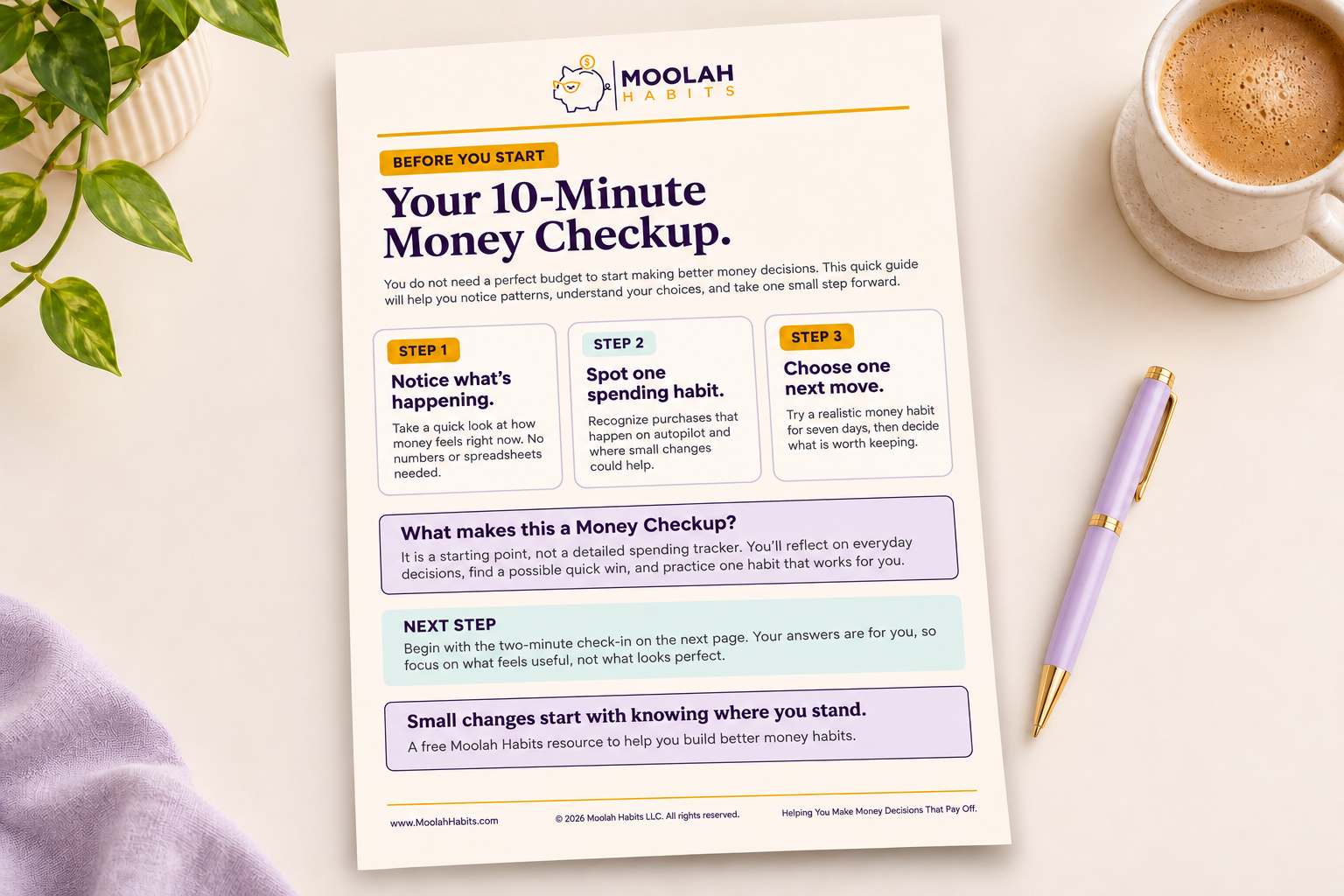
For a simple place to start, get the free 10-Minute Money Checkup using the form below. It helps you notice your money habits and choose one small next step.