Your Bank Balance Is Not Your Budget
From Moolah Habits · Financial coaching experience and credentials
Your checking account balance is not the same as money available to spend. Learn how to subtract bills, savings, and planned expenses to find the number that actually matters.
The Short Answer
Your bank balance shows what is in the account, not what is free to spend. Subtract money committed to bills, savings, debt payments, and planned expenses to estimate your available spending money.
You open your banking app and see $1,500 sitting in checking.
For a second, that number can feel reassuring. It may even feel like permission to spend.
But the balance in your checking account is not the same thing as the amount you actually have available.
Some of that money may already belong to bills, groceries, savings, or expenses that have not happened yet. That is where the checking account trap begins.
$1,500 in Checking Does Not Mean $1,500 Available
Your bank balance tells you how much money is physically in the account. It does not tell you how much of that money is already spoken for.
If you have $1,500 in checking but still need to cover rent, utilities, insurance, groceries, gas, debt payments, savings, and upcoming expenses, then the full $1,500 is not really available to spend.
That is the difference between a bank balance and a budget.
Start with Upcoming Bills
The first step is to look at what still needs to come out before the next paycheck.
Example: Checking balance $1,500; Upcoming rent $700; Utilities $180; Insurance $120; Groceries and gas $250. That is already $1,250 committed.
The bank still shows $1,500 until those payments leave the account, but your budget should already count them.
Then Subtract Savings
Savings should not be treated like whatever happens to be left over.
If you are working toward an emergency fund, vacation, car repair fund, holiday spending, home repair, or future purchase, that money also has a job.
If you planned to save $100 from that $1,500, then your available amount gets smaller again. That means you are giving the money a purpose before it disappears into everyday spending.
Planned Expenses Count Too
Some expenses do not happen every month, but they still need room in the budget: birthdays, school costs, pet expenses, car maintenance, medical copays, annual memberships, and holiday spending.
If you know they are coming, they should be part of the plan now. That is how you keep future expenses from turning into surprises.
What Is Left Is the Number That Matters
Once you subtract upcoming bills, savings, groceries and transportation, and planned expenses, what remains is the number that is actually available for flexible spending.
That number may be very different from the balance you see in your account. And that is the number that should guide your spending decisions.
A Simple Example
Let’s say your checking account shows $2,000.
But you still need rent $900, utilities $200, groceries and gas $300, savings $150, and upcoming expenses $200. Total already assigned: $1,750. Available to spend: $250.
Your bank balance says $2,000. Your budget says $250. That difference matters.
Why the Bank Balance Can Be Misleading
The checking account balance is always visible. The future bills are not.
That makes it easy to spend based on the number sitting in the account instead of the plan behind it, especially when bills are set to autopay, expenses happen later in the month, savings transfers have not happened yet, or irregular expenses are coming up.
The money may still be in the account, but that does not mean it is free to use.
Give the Balance Some Context
Instead of asking, ‘How much money is in checking?’ try asking, ‘How much of this money is already committed?’
That one change makes the account balance much more useful. You are not ignoring the number. You are giving it context.
The Takeaway
Your bank balance is not your budget. It is only the starting number.
Before spending from it, subtract what already has a job: bills, savings, groceries, and planned expenses.
What is left is the number that actually matters.
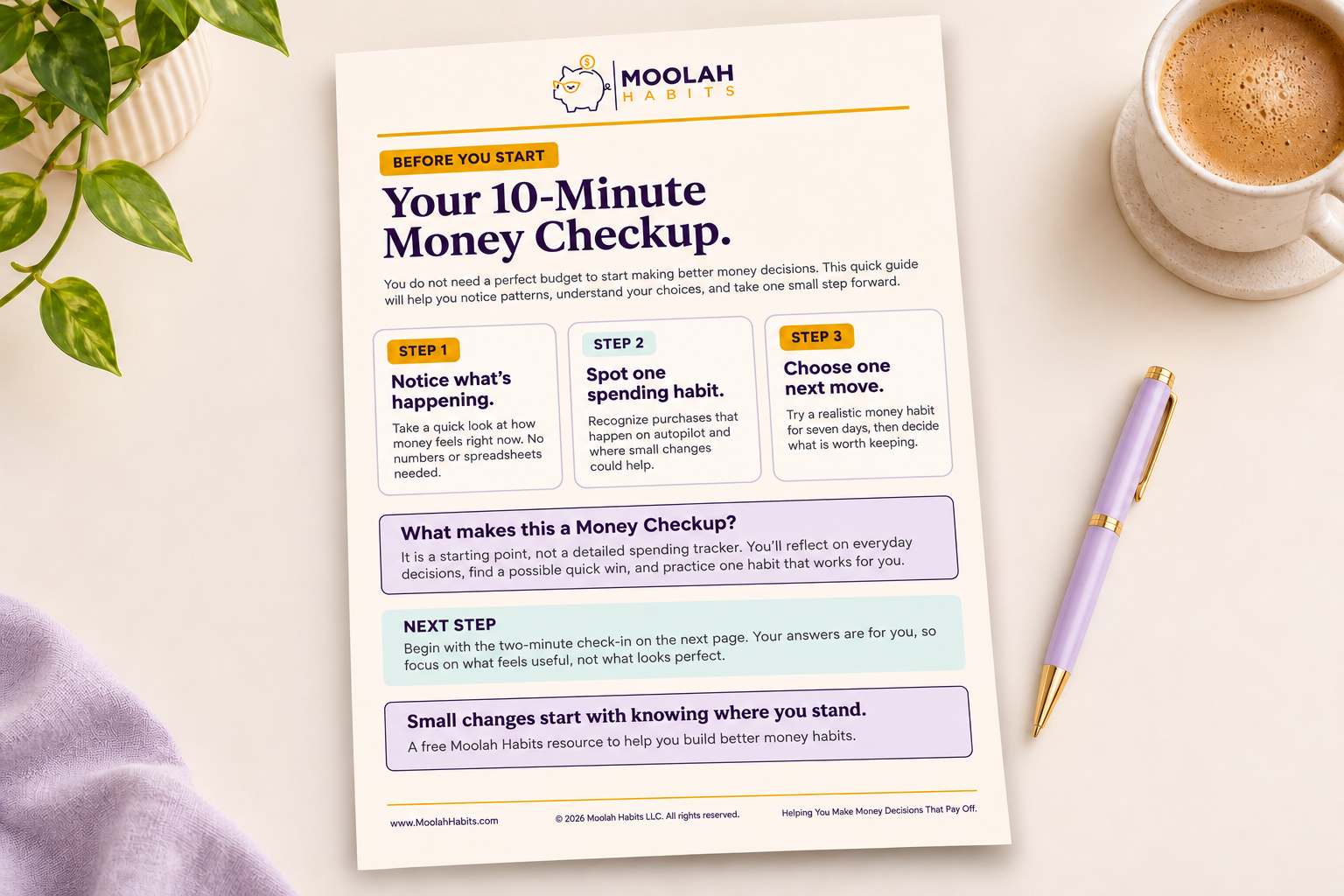
For a simple place to start, get the free 10-Minute Money Checkup using the form below. It helps you notice your money habits and choose one small next step.